

Key messages
- Justice and security are strengthened by centring people’s rights, needs and experiences.
- Combining systems thinking, adaptive programming and human rights principles fosters inclusive and accountable systems.
- The approach delivers tangible benefits by enhancing legitimacy, resilience and development outcomes.
- Transforming systems requires engaging the diversity of State, non-State and hybrid justice and security actors.
- Justice and security is about addressing immediate needs and structural drivers of injustice and insecurity.
2.1 Why the people-centred approach to justice and security matters
The people-centred approach to justice and security is critical for advancing the rule of law and preventing or mitigating rights violations, democratic backsliding and conflict. While not a panacea, it offers a systemic and sustainable path to resilience. It serves as a stabilizing force by reasserting the social contract, rebuilding trust between people and institutions, and promoting inclusive processes where people shape justice and security solutions. This matters because when people experience justice and security systems as fair, accessible and accountable, it strengthens institutional legitimacy and fosters commitment to the rule of law.
Justice and security are shaped by a wide variety of State, non-State and hybrid actors (“hybrid” actors are those that straddle State and non-State authority). The approach requires engaging this broad set of actors, not only formal institutions. It also addresses the underlying drivers of injustice and insecurity. It tackles structural inequalities and power imbalances, such as gender exclusion or unequal access to natural resources; supports bottom-up reform through local actors (e.g., customary leaders, paralegals, civil society); and invests in adaptive systems change that aims to shift power, not just provide technical fixes.
Democratic backsliding is often preceded by weak civic participation, exclusionary justice systems, and centralized or militarized responses to dissent. The approach helps counter this erosion by empowering communities to hold institutions accountable. It anchors rule of law not in the actions of elites (i.e., political, judicial, or international actors) to pass laws or support institutional reforms, but in social legitimacy: the extent to which people view formal institutions as fair, accessible, responsive and respectful of their dignity and rights.
The approach rebuilds and strengthens that legitimacy by ensuring formal institutions listen to communities, adapt service delivery based on what they hear and report back on the changes made. This creates feedback loops that help institutions remain responsive, adaptive and grounded in public expectations and needs. These mechanisms can also serve as important early warning systems for grievances, injustice or conflict.
Justice and security are essential public goods. The State, as the primary duty bearer, has a fundamental responsibility to ensure they are available to all people. As rights holders, all people are entitled to access justice and security without discrimination and to hold all service providers accountable (whether they are State, non-State or hybrid). The approach also recognizes that legitimacy is often negotiated among State and non-State actors, particularly in plural or hybrid governance settings. By creating space for inclusive dialogue and collaboration, it supports systems that reflect how people actually seek justice and security in practice.
The approach can help prevent relapses into conflict and support long-term peace by strengthening local justice infrastructures such as court user committees, paralegals, mediation forums and legal aid; empowering people and communities to know and realize their rights through, for example, legal awareness and support to civil society, media and human rights defenders; and building accountability networks that include formal and informal mechanisms such as ombudspersons, human rights institutions, police–community forums or local peace committees. By grounding justice and security in inclusive and participatory systems, it enhances a society’s capacity for conflict transformation, enabling people and institutions to address injustices and historical grievances, transform relationships, and resolve disputes through peaceful, inclusive and rights-based processes.
The approach strengthens the foundations of legitimate and accountable governance by ensuring that when government authorities overreach or State structures are weakened, societies retain the means to restore justice, protect rights and rebuild peace. It helps recalibrate the relationship between State and society, reinforcing the roles and responsibilities of both and ensures justice and security systems remain responsive, inclusive and resilient through times of stability, crisis or transition.

2.2 Benefits of the approach
The cost of injustice and insecurity
Unresolved justice and security problems carry profound human and economic costs. In 2024, the global economic impact of violence reached $19.97 trillion—equivalent to 11.6 percent of global gross domestic product (GDP), or $2,455 per person. More than 123 million people were forcibly displaced, and approximately one-quarter of the world’s population lives in places affected by conflict. Insecurity causes human suffering, disrupts economies and undermines development gains.
More than 5 billion people face at least one unmet justice need. These needs range from unresolved legal problems such as lack of legal identity or land tenure to living in extreme conditions of injustice such as statelessness or modern slavery. The OECD estimates that these justice gaps cost economies between 0.5 and over 3 percent of GDP through lost income, health impacts and legal costs.
Injustice and insecurity are not just development challenges. They are economic and social liabilities. Investing in people-centred justice and security systems is therefore both a development necessity and a strategic investment in peace, stability and inclusive growth.
Tangible benefits for different actors
This section highlights some of the tangible benefits the people-centred approach offers for people and communities, governments, development partners and UNDP.

Benefits for people and communities
- Stronger protection of rights and safety: People-centred justice and security systems protect individuals and communities from violence, exclusion and discrimination. They expand access to justice and security services for all people, especially those most at risk of being left behind; they empower people to understand and claim their rights; and they help prevent and address rights violations, including GBV and harms affecting children, minorities and displaced people.
- Greater empowerment and local ownership: When communities, especially women and marginalized groups, help shape justice and security services, they gain voice, agency and trust. Co-designed solutions are more effective and sustainable because they reflect and respond to local priorities and are more likely to be used, supported and maintained over time.
- Safer communities and increased trust in authorities: When justice and security providers engage communities, people feel safer and are more likely to trust and use these services. Responsive systems foster trust, reduce conflict risks and promote cooperation. Over time, this trust encourages people to invest in their communities—by starting businesses, joining cooperatives, participating in local governance, supporting development projects or engaging in civic associations. These actions strengthen local development, social cohesion and community resilience.
Benefits for governments
- More efficient services that support economic activity: People-centred justice systems improve service delivery by resolving cases faster, reducing public costs (e.g., detention and court administration) and better meeting the priority justice needs of people. In Kenya, the nationwide expansion of Small Claims Courts, which handle commercial disputes involving less than 1 million Kenyan shillings, resolved over 68,000 cases in the first three years of operation and released 12.6 billion Kenyan shillings (approximately US$100 million) back into the economy. Efficient, accessible justice improves institutional performance and enables economic participation and growth.
- Greater local and global trust and legitimacy: Fair, responsive institutions build public trust and State legitimacy. Trusted police and justice services encourage people to comply with laws, report crime and engage with authorities, which are critical for safer communities and more effective governance. People-centred reforms align with international commitments to justice, security, human rights and inclusive governance. They contribute directly to national efforts to deliver on 2030 Agenda’s call for peaceful, just and inclusive societies (Sustainable Development Goal [SDG] 16), while also enhancing governments’ global standing and unlocking cooperation on development and trade.
- Conflict prevention, peace and security: The approach enables governments and communities to address tensions before they escalate into violence. Resolving underlying grievances, such as land disputes or community tensions, through legal aid, mediation or dialogue, can prevent conflict and reduce the need for costly security responses. Justice systems that are accessible and trusted play a critical role in maintaining peace, preventing cycles of violence and building lasting security.
Benefits for development partners
- Higher impact and value for money: People-centred justice and security interventions deliver strong returns by focusing on services people actually use. In Bangladesh, investment in village courts yielded benefit–cost ratios of up to 18:1 (i.e., 18 dollars in economic and social benefits for every 1 dollar invested). These initiatives can unlock wider development progress by resolving legal barriers to health, education, livelihoods or economic participation (e.g., through civil documentation, access to alimony or the recognition of land rights). For development partners, this means greater and more sustained impact across sectors per dollar invested.
- Sustainable, locally owned results: By investing in local capacity and leadership, the approach ensures that results endure beyond a project’s life cycle. Services built with local commitment and ownership, such as community paralegals or community policing forums, tend to remain active and effective after donor funding ends. This reduces the risk of reforms backsliding and supports long-term impact. Sustainability is further strengthened when these initiatives include mechanisms for ongoing feedback, accountability and adaptation. Grounding interventions in people’s needs and experiences also enables better targeting, monitoring and evaluation of outcomes.
- Reduced risk and stronger development returns: The approach protects development gains and reduces future risks. By addressing root causes of instability, it supports more resilient, investment-ready societies. Fair, effective institutions foster trust, rule of law and stable environments where cooperation on trade, mobility and security becomes more viable. This aligns with donor strategies that seek to balance economic goals with governance, rights and inclusion. Early investment in locally driven justice and security can help prevent crises, reducing future spending on humanitarian aid and emergency response.
Benefits for UNDP
- Strategic alignment and leadership: The approach reflects UNDP’s core commitment to human development, human rights and inclusive governance. It enables UNDP to deliver justice and security programming that is accessible, accountable and people-centred, strengthening governance, reducing inequality and fostering peace. It reinforces UNDP’s contribution to SDG 16 by promoting justice and security systems that are not only effective but also responsive and accountable to people’s rights and needs. This strategic coherence reinforces UNDP’s credibility as a trusted partner and convener, positioning it to lead dialogues, shape policy and drive collective action on justice and security.
- Holistic and integrated programming: The approach enables UNDP to integrate justice and security efforts across sectors, designing joined-up interventions that address both symptoms and root causes of insecurity or injustice. This supports UNDP’s portfolio approach and focuses on transforming systems rather than treating isolated problems. The approach aligns with UNDP’s emphasis on systemic development solutions and leverages its broad expertise in a coordinated way.
- Innovation, learning and adaptability: The approach fosters adaptive, evidence-based programming. By grounding interventions in people’s experiences and adjusting based on feedback and data, UNDP can innovate and improve outcomes. This leads to more effective, scalable results, whether refining a pilot service or iterating reform policies based on community input. It supports UNDP’s commitment to learning and innovation, and enables high-quality support to governments, civil society and communities.
2.3 Defining the approach
The people-centred approach places people’s rights, needs and experiences at the centre of efforts to strengthen justice and security systems. Rather than viewing justice and security solely through the lens of the State and its institutions, the approach focuses on how justice and security are experienced by people, especially those who are marginalized, vulnerable or at risk of being left behind.
At its core, the approach envisions justice and security systems that are equitable, accessible, responsive and accountable to the people they are meant to serve, especially the most vulnerable and marginalized. This means engaging the full range of State, non-State and hybrid actors, institutions and mechanisms that together shape people’s justice and security outcomes. The goal is to ensure these diverse actors deliver high-quality, accountable and effective justice and security services in line with human rights standards.
This requires a shift from conventional State-centric approaches to a people-centred one. It does not mean focusing solely on communities or moving away from support for State institutions. Rather, it emphasizes the importance of strategically combining community-driven and institution-focused interventions in a mutually reinforcing way. Community action empowers people, especially the vulnerable and marginalized, to articulate their needs, claim rights, shape solutions and hold justice and security providers to account. Institutional reform, in turn, is essential to address systemic barriers, embed rights protections, and ensure high-quality, fair and accountable service delivery. When pursued together, these two levels create cycles of change that strengthen trust, responsiveness and legitimacy across the justice and security system as a whole.
People-centred justice and security is sometimes confused with terms such as “community-based”, “access to justice” or “community security.” While these are related, they are not the same. (See Box 2 for further explanation.)
Injustice, insecurity and exclusion are both symptoms of deeper systemic problems and drivers of instability and inequality. When these problems go unresolved, grievances grow, trust in institutions erodes, and the risk of conflict or violence increases. The approach seeks to address both the underlying causes and the visible consequences of injustice and insecurity by supporting systems that are fair, effective, and capable of protecting and upholding people’s rights and responding to their needs.
The approach is fundamentally rights-based. Justice and security systems are effective, responsive and accountable when they protect, promote and fulfil human rights and advance the dignity and well-being of all people. The approach builds on the Human Rights-Based Approach (HRBA), which provides both the legal and normative framework and is a complementary programming approach grounded in participation, accountability and non-discrimination. The HRBA is anchored in the human rights obligations that countries have committed to and have a legal obligation to fulfil. It focuses on the accountability relationship between duty bearers (primarily the State) and rights holders (people), guided by international human rights standards and principles. The people-centred approach complements and extends this by focusing on people’s everyday experiences of justice and security. It considers the roles of diverse State, non-State and hybrid actors, and the quality of justice and security services and outcomes that people receive. Together, the two approaches are mutually reinforcing, grounded in shared principles of participation, empowerment, accountability, and the strengthening of the capacities of both duty bearers and rights holders.
The approach supports greater coherence and integration between State and non-State systems to more effectively meet justice and security needs in line with human rights standards. It envisions the State and society as partners: people have agency and participate in shaping the services that affect their lives, while governments fulfil their responsibility to provide justice and security for all. Justice and security are not only public services but also essential to the social contract—a foundation of legitimacy, trust and accountability between people and the State.
The approach is anchored in the commitment to Leave No One Behind and to advancing gender equality and women’s empowerment. It prioritizes the rights, needs and voices of those most marginalized, ensuring their meaningful participation in shaping solutions to justice and security problems. By tackling exclusion and inequality and promoting inclusive, gender-responsive outcomes, the approach upholds rights, responds to diverse needs and addresses systemic disparities, particularly those related to gender and intersecting inequalities
Table 4: How Leave No One Behind, HRBA, and the people-centred approach support justice and security programming
| LEAVE NO ONE BEHIND | HRBA | THE PEOPLE-CENTRED APPROACH | |
|---|---|---|---|
| Role and focus | A guiding principle of the 2030 Agenda for Sustainable Development. It is a political commitment made by Member States. It focuses on addressing the immediate, underlying and root causes of the deprivations, disadvantages or discriminations that cause people to be left behind. | A programming approach and problem-solving tool to ensure development policies and programmes are anchored in international human rights standards and principles. It focuses on strengthening accountability by developing the capacities of both duty bearers to meet their obligations and rights holders to claim their rights. | A strategic and programming approach that strengthens the social contract by making justice and security systems accessible, accountable and responsive to people. It focuses on how people experience and seek resolution to their justice and security problems, and whether systems respond to their rights, needs and priorities. |
| How they work together in justice and security programming | Sets the priority: Focuses on reaching those furthest behind, addressing discrimination and exclusion. | Provides the normative framework: Anchors interventions in rights, accountability and non-discrimination. | Operationalizes the change: Makes justice and security systems trusted, accountable, and responsive to people’s rights and experiences. |
| Cross-cutting principles | Empowerment and agency, participation and inclusion, accountability, equality and non-discrimination. | ||
| Key resources | UNSDG, Operationalizing Leaving No One Behind: Good Practice Note for UN Country Teams (2022). | UNDP, The Human Rights-Based Approach to Development Programming: HRBA Toolkit (2025). | UNDP, The UNDP People-Centred Approach to Justice and Security: A Policy Framework for Justice and Security Programming (2025). |

2.4 The core elements of the approach
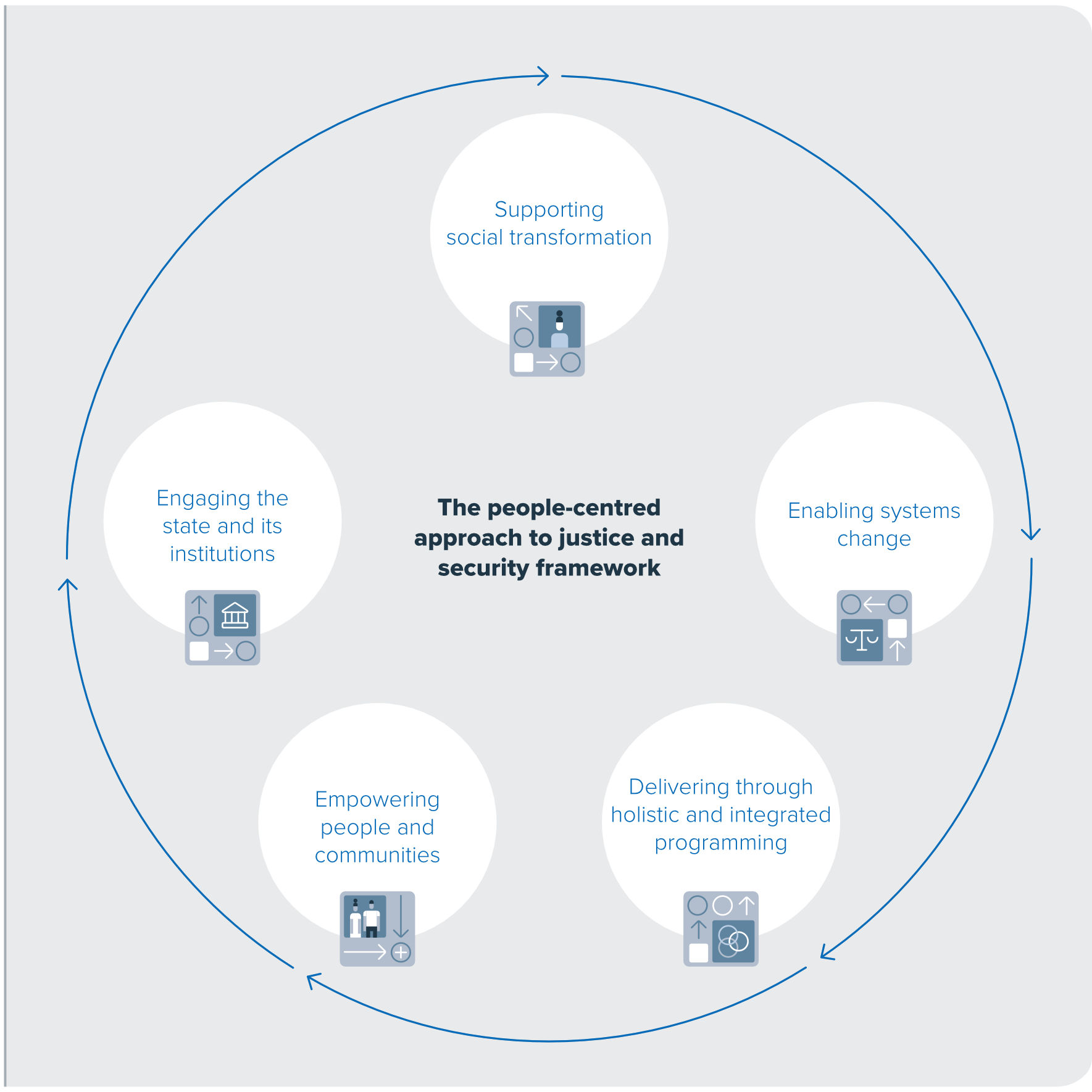
The people-centred approach is operationalized through a strategic framework built around five interlinked and mutually reinforcing elements. Grounded in human rights, inclusion and participation, empowerment, local ownership, and accountability, these elements guide how justice and security programming is designed, implemented and adapted. They provide an integrated foundation for long-term transformation across systems, institutions and communities. These five elements (see Diagram 3) are not a checklist, but a sustained approach to building justice and security systems that are accessible, inclusive, responsive and accountable to all people.
Element 1: Supporting social transformation
Enabling the emergence of trustworthy, accountable, accessible and responsive justice and security systems that protect people’s rights, respond to their needs and expectations, and strengthen trust and the social contract for peace and sustainable development.
Element 2: Enabling systems change
Navigating the complexity of justice and security systems through problem-driven, context-specific and adaptive programming that responds to people’s actual experiences. The approach recognizes the diversity of State, non-State and hybrid actors who deliver justice and security, and supports change across the system as a whole, not just within individual institutions.
Element 3: Delivering through holistic and integrated programming
Addressing both the symptoms and structural causes of injustice and insecurity by strategically combining community-driven and institution-focused interventions in ways that are mutually reinforcing. This requires integrated, multisector and multidisciplinary responses across national, local and sectoral levels.
Element 4: Empowering people and communities
Engaging and empowering people, communities and civil society to know and claim their rights and to participate meaningfully in shaping responses to their justice and security needs. This includes inclusive, participatory processes that build agency and strengthen accountability.
Element 5
Engaging the State and its institutions
Transforming formal institutions to deliver high-quality, accountable and effective justice and security services for all people, especially those most at risk of being left behind. This includes enabling personnel to lead and sustain change and ensuring services are trusted, accessible and legitimate in the eyes of those they serve.
Diagram 2: Elements of the UNDP people-centred approach to justice and security framework
The people-centred approach and its framework offer both a strategic lens and a practical pathway to strengthen justice and security systems. While not all interventions can address the whole system at once, the approach provides long-term direction for making services more inclusive, effective and accountable. This Guide supports teams to apply the approach in adaptive, context-sensitive ways that respond to people’s rights and needs and promote sustainable transformation.
2.5 Key messages for implementing the people-centred approach
The approach challenges conventional ways of understanding and addressing justice and security. It shifts the focus from institutional reform alone to how people experience justice, security and rights in their daily lives. The key messages below highlight core shifts in perspective that are essential for guiding implementation. They provide a foundation for programming that is responsive to people’s rights and needs, and that supports inclusive, accountable and trusted justice and security systems.
Justice and security are about people
The approach focuses on how individuals and communities experience justice and security in their daily lives, not only on how courts, police or legal systems perform. People’s rights, their priority needs, and experiences must guide how justice and security are understood, delivered and measured. Strengthening formal institutions is important, but their legitimacy and impact depend on how well they serve people, uphold rights and respond to people’s needs.
Justice and security reflect power and must be analysed politically
Justice and security are shaped by social, political and economic dynamics that determine who can obtain fair outcomes, access services and participate in decision-making and who is excluded. Understanding these dynamics—including power relations, incentives and institutional interests—is essential for identifying where change is possible and for promoting more inclusive, accountable and responsive systems.
People use multiple justice and security pathways
People resolve justice and security problems through a range of pathways, including State institutions, non-State and hybrid actors, and community-based mechanisms. The approach engages with this plurality and seeks to ensure that all pathways are accessible, accountable and uphold the rights of those who rely on them, especially those most at risk of exclusion or harm.
Justice and security are integral to peace and development
The approach recognizes that people’s justice and security needs are closely linked and often connected with other development issues such as land, livelihoods, education and health. Their interdependent nature requires integrated responses. Injustice and insecurity are both symptoms and drivers of conflict and underdevelopment, reinforcing cycles of exclusion, instability and inequality. Justice and security are essential for sustainable peace and development: they enable the delivery of inclusive public goods, support social cohesion and create the stability needed to advance all other development goals.
Legitimate systems require trust, empowerment and accountability
Justice and security systems are more legitimate when services are fair, accessible, responsive and accountable to all people, especially the most vulnerable and marginalised. Empowering people, particularly women, youth and other excluded groups, to participate meaningfully in these systems is essential. When communities shape how justice and security services are delivered, they gain voice, agency and trust in the system, strengthening both accountability and the social contract.
Evidence must reflect people’s needs, experiences, and outcomes
People-centred programming requires data and evidence of people’s perspectives, their needs and experiences of seeking justice and security. Data informs action, drives accountability and supports learning. Combining quantitative and qualitative data helps reveal barriers, capture diverse needs and identify where rights may be at risk, informing effective responses. Community participation in data collection and use ensures that information empowers people and guides decisions that reflect their priorities and improve justice and security outcomes that uphold their rights.