

The Stakeholder Influence Tool, developed by Leanne McKay, helps teams assess how different actors are likely to support or resist a proposed change, and how much influence they have over its success.
Stakeholder mapping and political economy analysis help identify who holds power (formally and informally), what interests shape their behaviour, how they are positioned in relation to change and what alliances or resistance may arise.
The Stakeholder Influence Tool helps teams to map how different stakeholders are likely to respond to a proposed intervention and how much influence they have over its success. It focuses on stakeholders’ alignment (support, resistance, neutrality) towards a specific change intervention. It builds on stakeholder mapping and draws from power and political economy analysis (PPEA) to support strategic engagement, risk navigation and adaptive programming. The tool can be used at any stage of the programme cycle. It is especially useful when:
- Identifying programming entry points
- Anticipating resistance or risks
- Adapting engagement strategies during implementation
How the tool works
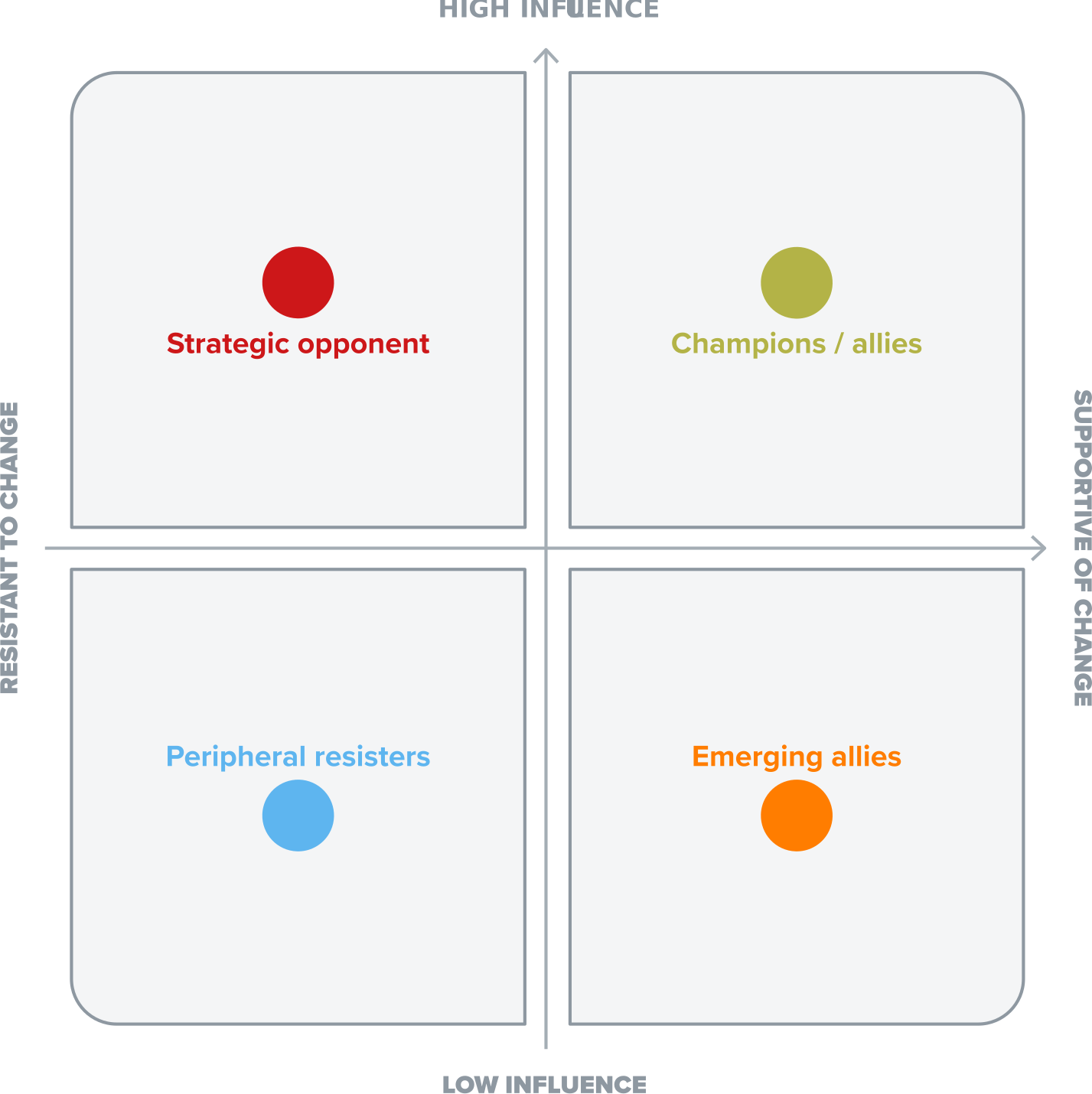
The tool maps stakeholders across two dimensions:
- Level of influence over a justice or security issue (high or low)
- Position on change (supportive, resistant, or neutral)
This allows teams to identify:
- Champions or potential allies (high influence, supportive)
- Stakeholders to engage or manage carefully (high influence, resistant)
- Marginalized actors to empower (low influence, supportive)
Actors with limited impact (low influence, resistant)
The tool supports PPEA analysis by:
- Translating PPEA insights into practical decisions by clarifying where influence lies and how different actors relate to a proposed change.
- Supporting adaptive programming by helping teams reassess relationships and engagement strategies as actors’ positions and influence shift.
- Identifying entry points and strategic actors that may otherwise be overlooked.
How to use the tool
Refer to your stakeholder mapping. Place each stakeholder into one of the four quadrants based on:
- Their level of influence over the issue (e.g., agenda-setting, gatekeeping, resource control)
- Their position regarding the proposed change (actively supportive, passively supportive, resistant, or neutral)
The quadrants are color-coded:
- The green quadrant is for champions and drivers of reform. Actively engage them and build coalitions.
- The orange quadrant is for emerging allies. Consider empowering them.
- The red quadrant is for active resisters. Consider whether and how to engage or negotiate with them.
- The blue quadrant is for peripheral resisters. Monitor them but be aware that they may not warrant major investment.
Use this analysis to identify:
- Who to engage, when and how
- Who are the champions of change and who are the spoilers
- Where to invest in trust-building, where to offer incentives and where to find shared interests or overlapping goals that allow actors to support the change
- How to monitor shifting alliances or interests
Examples of strategic allies in resistant contexts:
- A technocrat focused on efficiency and institutional performance
- A judge or police officer frustrated with impunity or dysfunction
- A government department seeking international legitimacy or foreign funding
These actors may not share people-centred goals, but their interests may partially align with justice and security reform. Mapping and engaging them can help to expand opportunities for change.
Things to consider when undertaking the analysis
Stakeholders’ positions and power:
- What are their interests?
- What potential losses or gains do they associate with change?
- Who do they influence—who could they persuade to support or oppose change?
- What resources or capacities do they have that could be harnessed for change?
What incentives might shift their position?
- Enablers of change:
- Who are the enablers—who has skills, funding or institutional access?
- Who are the influencers—who are the power and authority holders?