

Key messages
- A practical and flexible guide for use at all stages of the programme cycle.
- The people-centred approach applies across all contexts, including stable, transitional and crisis-affected settings.
- Justice and security are cross-cutting development issues that require coherence between sectors and integrated approaches to systemic change.
1.1 The purpose of the Guide
This Guide supports UNDP teams in translating the UNDP approach to people-centred justice and security (the approach) into effective, sustainable, and responsive programming. It offers structured steps, practical tools, and real-world examples to support the design, implementation, and adaptation of interventions that are context-specific, inclusive, and capable of driving long-term transformation of justice and security systems.
It is both a toolkit for action and a source of inspiration, whether teams are new to the people-centred approach or building on existing efforts. It encourages teams to start where they are (see Box 1: Start where you are), work with existing momentum, and identify opportunities for change, from the incremental to the ambitious.
The Guide is grounded in a core insight: justice and security systems evolve in complex and diverse ways across different contexts. There is no single starting point or model. Progress depends on political dynamics, institutional capacity, public trust and willingness to change. The guide emphasises experimentation, adaptation, and strategic navigation of political economy constraints, recognising that transformative change begins not with perfect conditions but through action.
The people-centred approach is both a programming method and a strategy for systemic change. It builds on UNDP’s commitment to inclusive governance and rule of law, access to justice, community security, and human rights. It responds to the complexity of justice and security challenges by focusing on the outcomes that matter most to people, such as trust, safety, fairness, accountability, and inclusion. This means starting with people’s actual experiences, working across formal (State) and informal systems, and embedding feedback and learning at every stage of programming.
The Guide helps UNDP teams to:
- Design inclusive, context-specific interventions informed by diverse perspectives
and data. - Support the transformation of justice and security systems to become more fair, accountable, trusted, and accessible.
It focuses on two interlinked areas:
- Improving programming so that interventions are adaptive, participatory and evidence-driven, supported by robust Monitoring, Evaluation and Learning (MEL) systems.
- Improving systems so that justice and security are not only delivered, but experienced in ways that are fair, trusted and rights-based.
The guide is applicable across diverse contexts, from stable governance settings to transitional and crisis-affected environments, and ensures that justice and security are embedded in broader development pathways, aligned with Agenda 2030 and the UNDP Strategic Plan 2026–2029.

The Guide is designed to be used alongside the UNDP people-centred policy framework laid out in The UNDP People-Centred Approach to Justice and Security (2025) and is complemented by thematic guidance on topics such as gender justice, customary and informal justice, and justice in contexts of forced displacement.

It builds on past guidance, including UNDP’s Practice Note: Access to Justice (2004) and Community Security and Social Cohesion: Towards a UNDP Approach (2009), and draws on UNDP’s work in adaptive management, systems thinking, the portfolio approach and programming in complex contexts.
While this Guide reflects UNDP’s own practice and learning, it also builds on the significant contributions of many other organizations and initiatives, such as the Hague Institute for Innovation of Law, the International Development Law Organization, the Organisation for Economic Co-operation and Development (OECD), Pathfinders for Peaceful, Just and Inclusive Societies, and Saferworld, that have advanced people-centred approaches to justice and security globally.
1.2 Who the Guide is for and when to use it
The Guide is intended for UNDP teams engaging with justice and security issues across different contexts. These include teams designing new interventions, adapting existing ones or reflecting on past programming (see Box 1). It is relevant to governance, rule of law, and justice and security teams, as well as those working in closely connected areas, including:
- Gender
- Conflict prevention and peacebuilding
- Stabilization
- Early recovery
- Environmental governance
- Climate, peace and security
It applies at all stages of the programme cycle and is relevant at the project, programme and portfolio levels.
Justice and security are cross-cutting development issues that arise in sectors such as health, livelihoods, education and climate. The people-centred approach therefore applies across a wide range of thematic and operational areas, beyond the conventional areas of justice and security programming (such as access to justice or community policing). Recognizing and strengthening these connections helps move towards more integrated, coherent programming and supports UNDP’s portfolio approach.

Table 1 presents an illustrative list of areas where justice and security dimensions are relevant, even if not always explicitly integrated in UNDP programming. These interventions are not people-centred by default; intentional efforts are needed to align them with people’s rights, needs and experiences. See Annex 10 for thematic spotlights on three of these areas: Digitalization and E-justice, Environmental Justice, and Business and Human Rights. Each spotlight provides resources and practical examples from diverse UNDP Country Offices to support integration of the people-centred approach within these thematic areas.
Table 1: Areas where justice and security are relevant in UNDP programming
| Justice | Security |
|---|---|
| Legal aid and legal empowerment (e.g., community-based paralegals, legal awareness) | Community security (e.g., community dialogues and forums, local security planning, cross-border initiatives) |
| Mobile courts and mobile legal aid | Security sector governance and reform (e.g., civilian oversight, institutions strengthening and capacity building, gender mainstreaming) |
| Institutions support and capacity building for formal justice institutions | Police reform and community policing (e.g., legislative reforms, training, accountability mechanisms) |
| Judicial oversight and accountability (e.g., complaints mechanisms, support to national human rights institutions, ombudspeople, parliaments) | Corrections (e.g., protection of detainee rights, institutional capacity and oversight) |
| Strengthening legal frameworks, including constitutional assistance | Early warning and conflict prevention (e.g., local peace committees and insider mediation) |
| Business and Human Rights (e.g., expanding accountability, improving access to remedy, empowering people) | Prevention of violent extremism |
| e-justice and digital transformation (e.g., case management systems, digital access platforms) | Small arms and armed violence reduction (e.g., SALIENT and SEESAC programmes) |
| Gender justice, including gender-based violence (GBV) focused justice services | GBV, including specialized police units, gender desks, training |
| Customary and informal justice | Stabilization, including restoring security, infrastructure rehabilitation, basic services delivery |
| Environmental justice | Climate security, including early warning, community security, conflict prevention |
| Transitional justice, reconciliation and restorative justice | Disarmament, demobilization and reintegration (DDR), specifically community-based reintegration |
| Support for displaced populations and durable solutions (e.g., legal identity; housing, land and property [HLP] rights; inclusive justice mechanisms) | Safe returns and durable solutions (e.g., community security, social cohesion) |
The approach applies across all contexts—from crisis prevention, response and recovery to long-term development. It supports prevention by addressing the root causes of injustice and insecurity, recognizing justice and security not only as an issue of institutional reform but also as a means to resolve conflict, address grievances and strengthen the social contract. It enables inclusive, rights-based responses across the Humanitarian–Development–Peace (HDP) nexus. In crisis and recovery settings, the approach helps ensure that efforts to address people’s immediate justice and security needs are not disconnected from the underlying drivers of injustice and insecurity. This helps prevent the re-entrenchment of harmful practices and supports more inclusive, accountable systems over time.
1.3 How the Guide was developed
This Guide builds on the extensive consultations that shaped the UNDP people-centred policy framework. Its development included additional online consultations with over 60 UNDP staff from global, regional and country offices. The content was further informed by a review of existing UNDP guidance notes, tools and reports, as well as evaluations published by the UNDP Independent Evaluation Office (IEO).
A reference group composed primarily of UNDP staff from country offices across all five regions and diverse development contexts provided feedback throughout the drafting process. The Guide also underwent formal peer review to strengthen its quality and coherence.
1.4 How to use the Guide
This Guide is a practical resource for designing and implementing people-centred justice and security programming in a way that is context-responsive, systems-informed and adaptive. It offers a structured yet flexible process to help translate the approach into action across design, implementation, learning and adaptation.
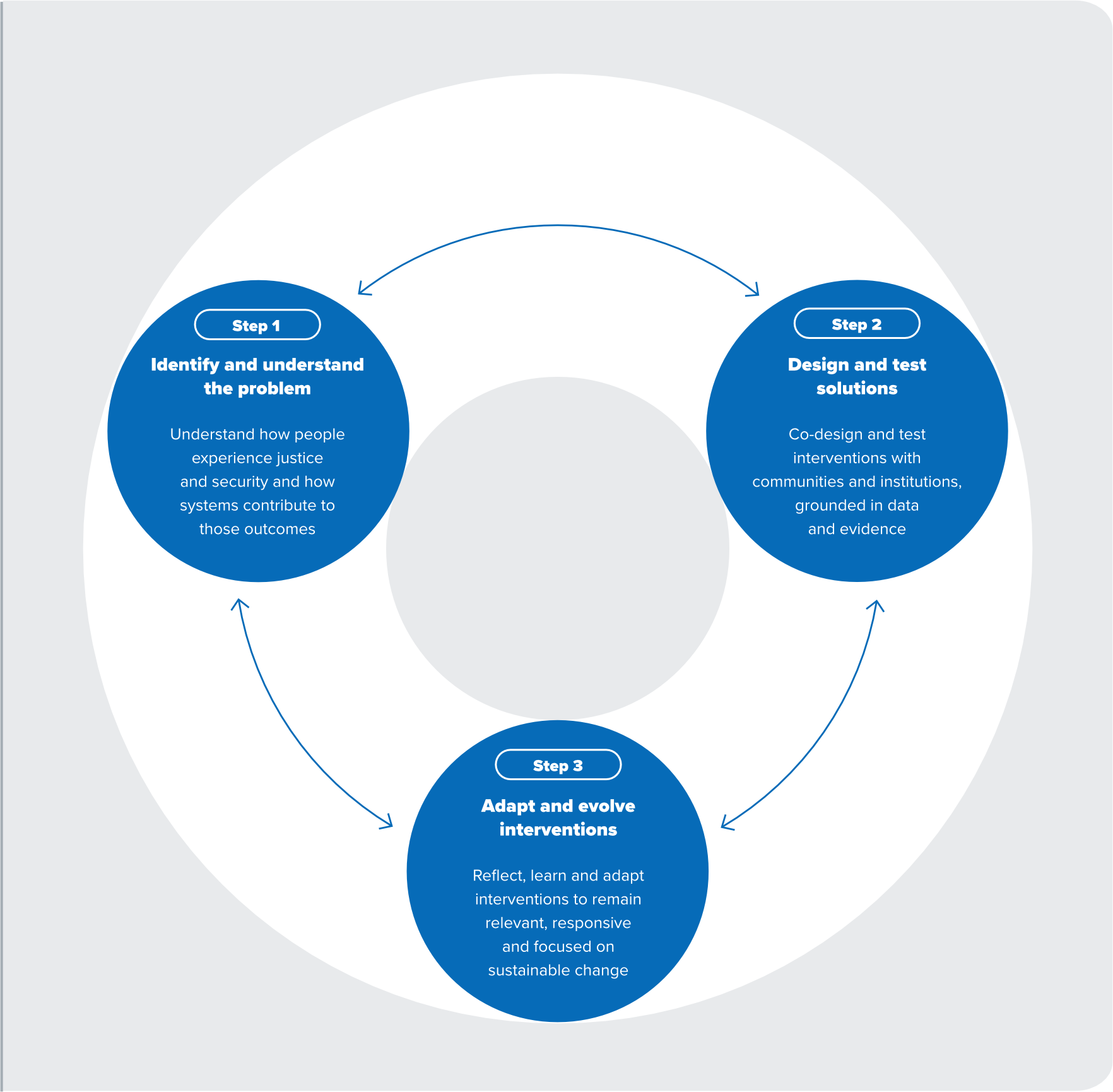
The Guide is organized around three interrelated and reinforcing steps, as shown in Diagram 1.
| Step 1 | Identify and understand the problem Understand how people experience justice and security and how systems contribute to those outcomes |
| Step 2 | Design and test solutions Co-design and test interventions with communities and institutions, grounded in data and evidence. |
| Step 3 | Adapt and evolve interventionsReflect, learn and adapt interventions to remain relevant, responsive and focused on sustainable change. |
Each step includes:
- Practical tools
- Guiding questions
- Country examples
- Programming tips and common pitfalls to avoid
- Links to additional UNDP and external resources
While presented here in three steps for clarity, the process of designing and delivering people-centred justice and security is not linear. The trio of steps are interdependent functions that reinforce one another throughout the programming cycle.
- Diagnosis is ongoing: Understanding the problem (Step 1) continues through implementation as new dynamics emerge.
- Design evolves: Testing solutions (Step 2) may reveal the need for adjustments to strategies (Step 1) or delivery (Step 3).
- Adaptation is continuous: Learning and reflection (Step 3) help ensure programming stays relevant and impactful, often prompting teams to revisit earlier steps.
This cycle of continuous learning helps teams stay grounded in people’s rights, needs and experiences, while supporting long-term systems change. It also enables teams to anticipate and respond to emerging risks and opportunities.
Diagram 1: The three-step programming process
What this Guide does not do
This guide does not cover all aspects of justice and security programming in detail. It does not offer technical guidance on every thematic area or prescribe specific models. Where tools such as political economy or conflict analysis are addressed in other UNDP or external resources, the Guide refers users to those materials rather than duplicating the
Navigating the Guide
The main text is punctuated by seven types of materials designed to enhance the Guide’s reader-friendliness, usefulness and impact.
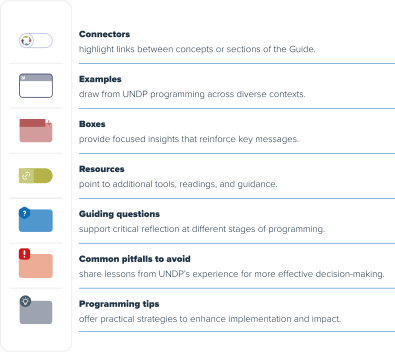
As shown in Table 2, the Guide is divided into seven chapters. At the heart of the Guide is the three-step process (design, implement and adapt) for undertaking people-centred justice and security programming; this process is introduced in Chapter 3 and the three steps are laid out in turn in Chapters 4, 5 and 6. Chapter 7 offers a short conclusion. At the end of the Guide are 10 annexes with practical tools and resources to support application of the approach in diverse programming contexts. Table 3 provides a quick reference to help readers locate key sections of the Guide in response to common programming questions.
Table 2: Content of the Guide
| Chapter 1 About this Guide | Introduces the purpose, scope and structure of the Guide. Explains who the Guide is for, how it was developed and how it can be used. Situates the Guide within broader UNDP strategies and shows how it complements other tools and resources. |
| Chapter 2 UNDP’s people-centred approach to justice and security | Explains what the people-centred approach is, why it matters and how it should guide justice and security programming. Outlines key benefits for people, governments, UNDP, and development partners; defines the core elements of the approach; and highlights key messages for effective implementation. |
| Chapter 3 Introducing the three-step programming approach | Outlines a three-step process (design, implement and adapt) for undertaking people-centred justice and security programming. Identifies the seven design principles that should guide such programming. |
| Chapter 4 Step 1: Identify and understand the problem | Sets out the vision of a people-centred justice and security system; introduces key enablers for effective problem diagnosis; and provides guidance for understanding people’s needs, how systems function and why they may not deliver fair outcomes. Includes tools and tips for stakeholder mapping, power and political economy analysis, conflict analysis and systems mapping. Concludes with diagnosing the problem based on evidence and people’s experiences. |
| Chapter 5 Step 2: Design and test solutions | Provides guidance on identifying programming entry points, including in politically constrained environments; co-creating solutions with communities and institutions; and testing interventions. Introduces the Six Dimensions Tool and the People-Centred Capacity and Integrity Framework. Includes tools, tips and country examples to support people-centred design, participatory implementation, integrated programming and the development of effective monitoring, evaluation and learning systems. |
| Chapter 6 Step 3: Adapt and evolve interventions | Focuses on using data, evidence and experience to adapt interventions, embed change in systems and support sustainable, people-centred outcomes. Provides practical guidance, tools and examples for reflection, learning, adaptation and scaling. Includes strategies for applying the approach in complex and volatile settings. |
| Chapter 7 Conclusion | Offers a brief conclusion that emphasizes the Guide is not a blueprint, but a practical resource to support context-specific and adaptive people-centred justice and security programming. |